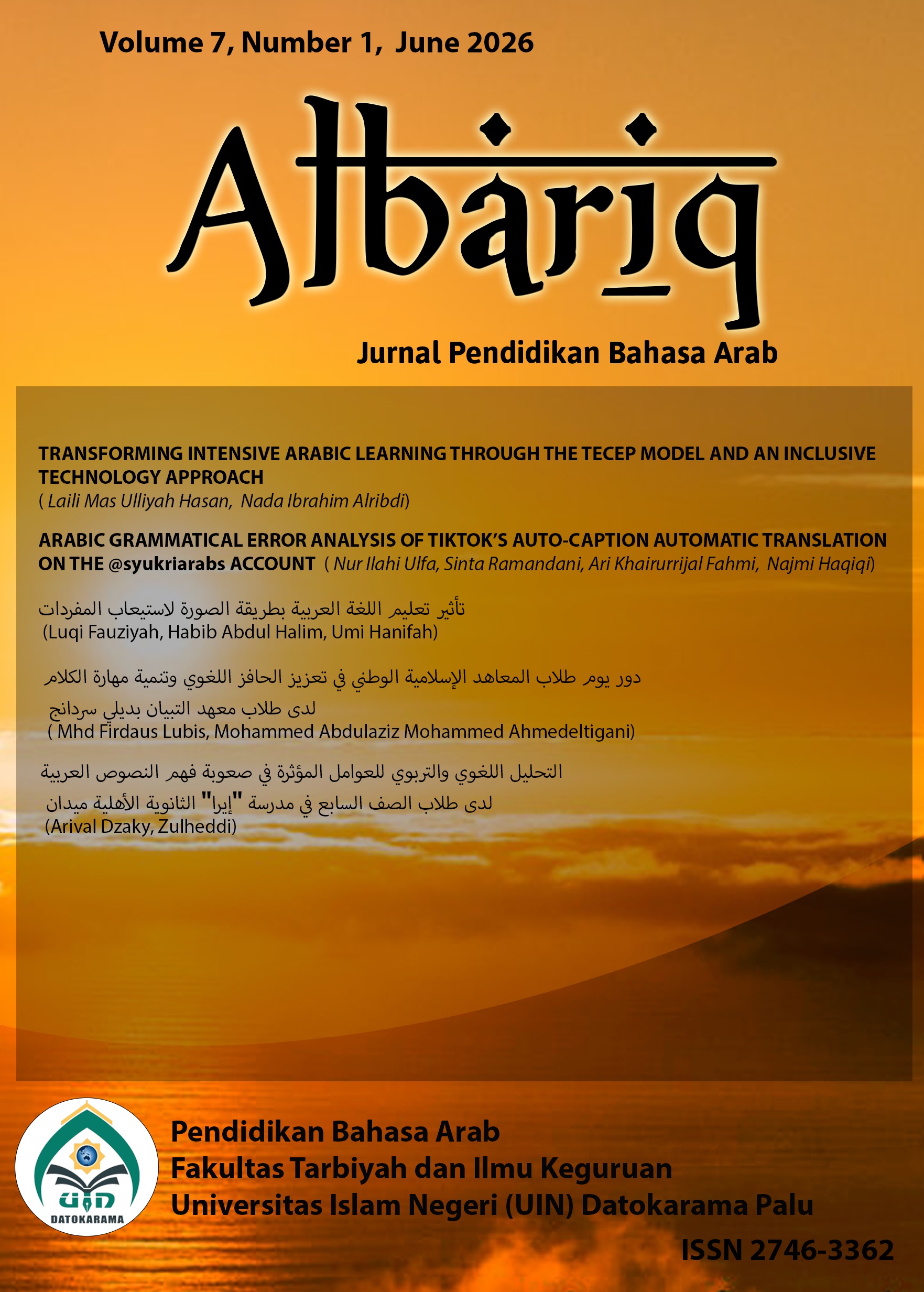
Arabic Grammatical Error Analysis of TikTok’s Auto-Caption Automatic Translation on the @syukriarabs Account
DOI:
https://doi.org/10.24239/albariq.v7i1.262Keywords:
TikTok auto-caption, Error analysis, Nahwu, Sharf, Artificial Intelligence (AI)Abstract
The development of Artificial Intelligence (AI) through TikTok's auto-caption feature offers conveniences in digital communication and Arabic language learning; however, the system frequently encounters errors when processing complex Arabic linguistic structures. While previous studies have extensively discussed Arabic error analysis in academic texts and machine translation applications, research exploring real-time grammatical errors in TikTok's auto-caption feature remains limited. This study aims to analyze Arabic grammatical errors in TikTok's auto-caption feature on the @syukriarabs account through the lens of Nahwu (syntax) and Sharf (morphology). This study employs a descriptive qualitative approach with a case study design. Data were obtained from 10 videos uploaded by the @syukriarabs account using the observation and note-taking technique. The data were then analyzed using S.P. Corder’s Error Analysis theory by comparing the original audio text, the generated auto-captions, correct grammatical forms, and the specific types of errors. The results indicate that the most dominant errors occur within the phonetic and morphological domains, particularly in the misdetection of speech sounds, alterations in wazan (morphological patterns), the omission of tanwin (nunation), pronoun (dhamir) shifts, and inaccuracies in syntactic elements such as particles and i'rab (inflectional endings). Furthermore, lexical and word segmentation errors were identified, causing semantic distortion. This study concludes that TikTok's auto-caption system remains oriented toward sound-matching rather than a comprehensive understanding of Arabic linguistic context.
Downloads
References
Alhafni, Bashar, Go Inoue, Christian Khairallah, and Nizar Habash, ‘Advancements in Arabic Grammatical Error Detection and Correction: An Empirical Investigation’, Journal Arxiv, 2 (2023), 1–19
Amien, Mukhlis, ‘Sejarah Dan Perkembangan Teknik Natural Language Processing (Nlp) Bahasa Indonesia: Tinjauan Tentang Sejarah, Perkembangan Teknologi, Dan Aplikasi Nlp Dalam Bahasa Indonesia’, Journal Arxiv, 1 (2023), 1–7
Aminullah, Muhammad Afiq, Fadilah Al Azmi, and Darul Jalal, ‘Pembelajaran Bahasa Arab Mandiri Melalui Platform Aplikasi Tiktok Sebagai Tren Belajar Masa Kini’, Al Mi’yar: Jurnal Ilmiah Pembelajaran Bahasa Arab Dan KebahasaAraban, 5 (2022), 283–302
Arifin, Moh Aziz, ‘Tren Perkembangan Pendidikan Bahasa Arab Di Era Digital : Suatu Kajian Pustaka’, Lisan An-Natiq, 72 (2025), 403–23
Azhar, Muhammad, Destia Yolanda, Angga Frananda, M. Ripani Saputra, Resy Mulyani, and Siti Nurdinah, ‘Al- Revolusi Pembelajaran Bahasa Arab Di Era Digital: Analisis Peran Artificial Intelligence Dalam Pengembangan Kompetensi Berbahasa Muhammad’, Al-Ma’luma, 3 (2025), 58–81
Bahri, Samsul, ‘Analisis Fungsi I’râb Dalam Bahasa Arab Antara Semantis Dan Estetis’, Al Qalam: Jurnal Ilmiah Keagamaan Dan Kemasyarakatan, 17 (2023), 1–10
Corder, S P, Error Analysis and Interlanguage, 1981
Dzulkahfi, Herry Sujaini, and Tursina, ‘Perbandingan Hasil Penerjemahan Neural Machine Translation ( NMT ) Dengan MarianNMT Terhadap Sumber Korpus Comparison of Neural Machine Translation ( NMT ) Results with MarianNMT Against Wikimedia and QED & TED’, JURISTI (Jurnal Riset Sains Dan Teknologi Informatika), 01 (2023), 151–59
Fahmi, Ismail, ‘Kesalahan Terjemahan Otomatis Tiktok Dalam Akun @Ahmad Rojih’, Maliki Interdisciplinary Journal (MIJ), 2 (2024), 1586–95
Firdaus, Rifqi Muhammad, Rohanda Rohanda, and Dayudin Dayudin, ‘A Linguistic Analysis of Arabic Language Errors in The Thesis Abstracts of Arabic Language and Literature Students at Uin Sunan Gunung Djati 2024’, International Conference on Language Learning and Literature (ICL3), 55 (2025), 145–57
Hanifansyah, Nur, and Menik Mahmudah, ‘Strategi Efektif Simplifikasi Nahwu Dalam Percakapan Arab Pada Kelas Intensif Daurah Ramadhan’, Kuras:Journal of Arabic Education, Linguistics and Literature Studies, 3 (2025), 35–48
Latipah, Ucu, Viqri Aditya, Ahmad Bukhori Muslim, Koderi, Zulhannan, and Amiruddin, ‘الاتجاهات في بحوث التحليل التقابلي والتحليل الأخطائي في تعليم اللغة العربية: مراجعة منهجية (2013-2025)’, Ta’limi: Journal of Arabic Education & Arabic Studies, 5 (2026), 189–217
Lutfiyatun, Eka, Depi Kurniati, and Nurul Fajriah, ‘Pemanfaatan Artificial Intelligence ( AI ) Dalam Tarjamah Dan Muhadatsah Di Perguruan Tinggi’, Seulanga: Jurnal Pendidikan Dan Pelatihan, 2 (2023), 93–105
Mas, Farrah Chaiya, and Muhammad Yunus Anis, ‘The Effect of Applying Arabic Translation Techniques on the Translation Quality Assessment of Al Jazeera Captions on TikTok Social Media’, Arabiyatuna, 8 (2024), 509–36
Nababan, Wiwik Romauli, Nadia Rahmadani, Wisdom Ortiz Valencia Tamba, and Taufiq Kurniawan Hidayat Nst, ‘Tantangan Bahasa Di Era Digital Terhadap Kesalahan Berbahasa Dalam Komunikasi Media Sosial’, Jurnal Bahasa Daerah Indonesia, 1 (2024), 1–9
Novel, and Charsan Hidayat, ‘Kesalahan Fonologi Dalam Bahasa Arab’, INNOVATIVE: Journal Of Social Science Research Volume, 4 (2024), 7719–30
Nurchasanah, Maryam, and Ari Khairurrijal Fahmi, ‘Pengaruh Wordwall Dalam Meningkatkan Minat Belajar Kosakata Bahasa Arab Pada Siswa Kelas VIII Di MTs Al Muddatsiriyah Jakarta’, Al-Fusha: Arabic Language Education Journal, 6 (2024), 37–43
Nurfitrayadi, ‘Desain Model Problem Based Learning Menggunakan Aplikasi Capcut Pada Pembelajaran Ski Dalam Meningkatkan Hasil Belajar Siswa Kelas X Man 1 Majene’ (Institut Agama Islam Negeri (IAIN) Parepare, 2024)
Pamungkas, Muhammad Ibnu, Dede Ahmad Satibi, Alwi Zakhratunnisa, and Aas Lestari, ‘Error Analysis of Consonant Pronunciation In Arabic Language Among Fifth-Grade Students’, Ta’lim Al-‘Arabiyyah: Jurnal Pendidikan Bahasa Arab Dan Kebahasaaraban, 8 (2024), 56–72
Prasong, Muthiah, and Pahlawan Pakro, ‘Analisis Kesalahan Menulis Kosa Kata Bahasa Arab Mahasiswa Pusat Studi Bahasa Asing (Psba) Stkip Muhammadiyah Kalabahi Tahun Ajaran 2023/2024’, Syntax Literate: Jurnal Ilmiah Indonesia p–ISSN:, 9 (2024), 5407–15
Rahmafillah, Nabila, and Ari Khairurrijal Fahmi, ‘Syntactic Error Analysis in Writing Arabic Sentences at Tsanawiyah Level and Its Implications’, El-Ibtikar Jurnal Pendidikan Bahasa Arab, 14 (2025), 38–54
Saragih, Sanju Febrio, and Selviana Napitupulu, ‘Language Errors in Tiktok Content Captions’, Jurnal Imu Pendidikan Dan Sosial (JIPSI), 4 (2026), 979–87
Satibi, Subaiki Ikhwan, and Milki Aan, Artificial Intelligence (AI) Dan Pendidikan Bahasa Arab: Sebuah Revolusi Pembelajaran Bahasa Arab, 1st edn (Bogor: Abdi Fama Group, 2025)
Shafira, Dirahima Berida, and Raden Arief Nugroho, ‘Translation Error Types Analysis on TikTok Indonesian-English Auto-Translation Content’, Atlantis Pess, 797 (2023), 45–5.
Sukmawati, Rosita Eka, and Nanda Nini Anggalih, ‘Perancangan Konten Media Sosial Tiktok Sebagai Promosi Desa Wisata Kampung Majapahit Bejijong’, Jurnal Barik, 6 (2024), 199–213
Syaifudin, Moh, Nafis Azmi Amrullah, M. Isroul Laili, and Kiki Cahya Muslimah, Linguistik Arab Di Era Digital: Teori, Praktik, Dan Kecerdasan Buatan (Kuningan: Goresan Pena, 2025)
Tafonao, Gabriel Delpiter, Desta Nataring Ge, Sinarti Ningsih Batee, and Arozatulo Bawamenewi, ‘Analisis Kesalahan Gramatikal Dalam Teks Akademik Mahasiswa’, TA’EHAO: Jurnal Ilmiah Pendidikan Bahasa Dan Sastra Indonesia, 1 (2026), 11–24
Umam, Ahmad Zaimul, Akhmad Ridlo, Mohamad Zaka Al Farisi, and Mad Ali, ‘Analysis of Translation Errors in Cnn Indonesia News Texts Into Arabic Through Perplexity.Ai Application’, JILSA: Jurnal Ilmu Linguistik & Sastra Arab, 8 (2024), 40–52
Zulharby, Puti, and Analisa Apriliani, ‘Kesalahan Penerjemahan Harf Jar Pembentuk Idiom Pada Mahasiswa Pendidikan Bahasa Arab’, Jurnal Alfazuna: Jurnal Pembelajaran Bahasa Arab Dan Kebahasaaraban, 6 (2021), 112–34
Downloads
Published
How to Cite
Issue
Section
License
Copyright (c) 2026 NIU, SNI, AKF, NJM

This work is licensed under a Creative Commons Attribution-NonCommercial 4.0 International License.
.png)